
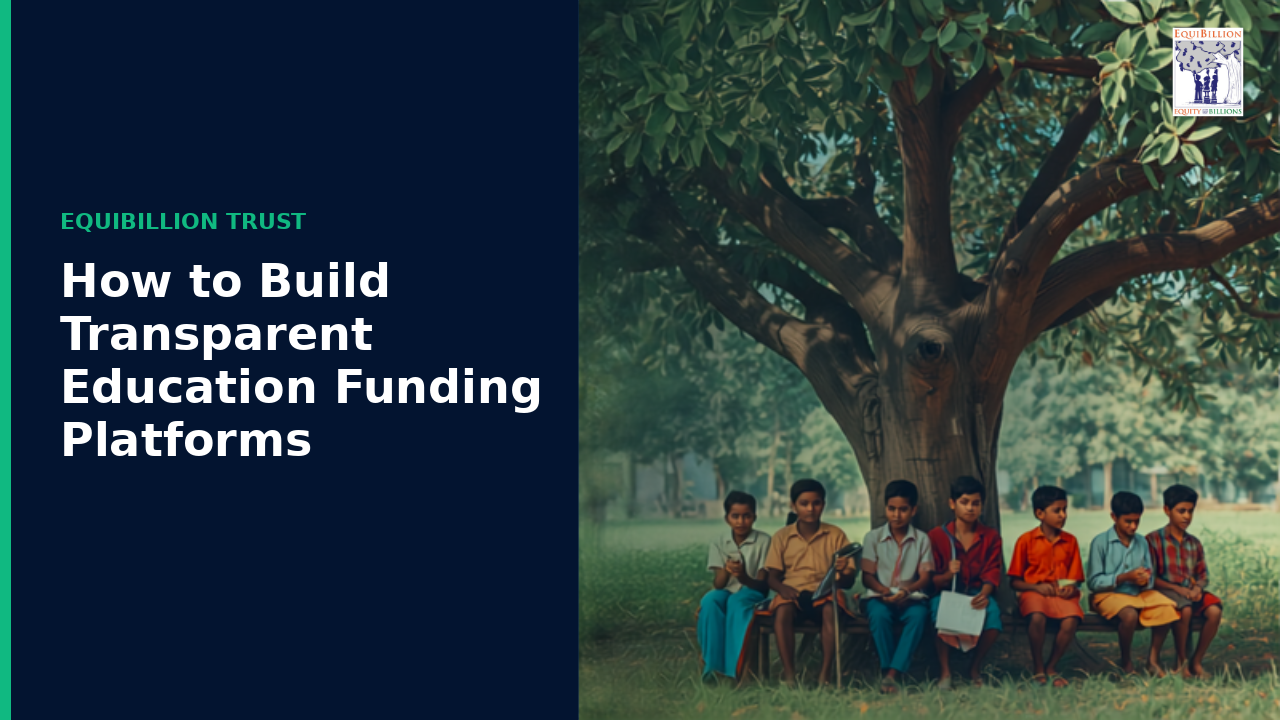
How to Build Transparent Education Funding Platforms
Learn how schools and NGOs can build transparent education funding platforms that earn donor trust, track every rupee, and deliver measurable learner impact across India.
EquiBillion Editorial
Content Team
When a child in a rural school learns to code, or a visually impaired student explores tactile programming for the first time, something remarkable happens — and the donors who made it possible deserve to witness every moment of it. Transparency is not just a compliance checkbox; it is the foundation upon which communities, schools, and funders build lasting trust. This is the story of how education funding platforms can be designed to honour every rupee, every donor, and every learner they serve.
Why Transparency Is the Core of Ethical Education Funding
Millions of rupees flow toward education causes across India every year, yet donor confidence continues to erode — not because people have stopped caring, but because impact remains invisible. Financial reporting alone is no longer enough. True transparency means making the entire journey visible: from the moment a campaign is created to the day a child holds a new skill in their hands.
When processes are opaque, repeat giving declines and community participation weakens. People give once, hear nothing, and quietly move on. But when funds reach beneficiaries as verified goods rather than cash transfers, when every step is documented, and when every rupee is publicly tracked, something shifts. Donors stop being transactions. They become mission partners.
This is not an operational detail — it is a values-driven design choice. Platforms built on 100% fund-tracking and public reporting create a virtuous cycle: trust generates generosity, generosity generates impact, and impact regenerates trust. Transparency, at its core, is how ethical education funding keeps its promise.
Start With Verified Campaigns and Clearly Defined Impact Goals
Transparent funding platforms must be built on a foundation of rigorous verification before a single campaign goes live. Every school or NGO seeking to raise funds should undergo a thorough review — registration certificates, financial records, and evidence of real field work must all be examined and confirmed. Listing an unverified partner is not a minor oversight; it is a breach of donor trust.
Equally important is specificity in campaign design. A goal like "help students learn" is well-intentioned but ultimately unconvincing. A goal like "fund a computational thinking programme for 120 students in a government school in Telangana" gives donors, implementation partners, and communities a clear, shared brief. It defines success before a single rupee is raised.
Whether a campaign is seeking to fund coding education, financial literacy, social-emotional learning, AI modules, or teacher capacity-building, the same verification rigour must apply. Credibility is not built campaign by campaign — it is either maintained consistently or lost entirely. Specificity is not bureaucracy. At scale, it is what separates trusted platforms from forgotten ones.
Design for Real-Time Visibility: Every Rupee, Every Milestone
The architecture of a transparent platform must answer one question at every moment: where does the money stand, and what will happen next? Donors should be able to see, in real time, exactly how much has been raised, what the funding target is, how many people have contributed, and what triggers deployment of funds.
Milestone-based fund release is one of the most powerful trust mechanisms available. When funds are deployed only after a campaign reaches its full target — never before, never in fragments — donors know that partial contributions cannot be misdirected or misused. There is no ambiguity, and no room for quiet diversion.
Technology must serve clarity, not complexity. Campaign dashboards and progress indicators should be intuitive for a first-generation donor giving from a small town and equally legible for a seasoned CSR officer at a corporate foundation. When a donor watches their contribution move a progress bar and then sees that bar trigger a real classroom intervention, the emotional connection to the cause becomes something far more durable than a one-time act of generosity. It becomes investment.
Close the Loop: Impact Reports as a Donor's Right
The post-funding phase is where most education platforms quietly fail — and where genuinely transparent ones earn their distinction. Raising funds is only half the commitment. Publishing what those funds actually accomplished is the other half, and it is non-negotiable.
After a campaign is fully funded and an educational solution is delivered, impact reports must be made available to every donor. These are not sanitised summaries. They should include photographs, video documentation, beneficiary stories, teacher feedback, and measurable learning outcomes — real evidence that the intervention landed as promised.
Implementation partners play a critical role here. Structured delivery, teacher training, and ongoing programme monitoring ensure that outcomes are genuine, not merely reported. When donors see the faces of the children their generosity reached, and hear from the teachers whose classrooms were transformed, a one-time transaction becomes a relationship.
And relationships compound. Donors who feel seen, informed, and respected do not stay quiet. They bring in alumni, colleagues, and family members. They share stories. They return. Closing the loop is not just good practice — it is the mechanism through which a single campaign grows into a movement.
Mobilise Communities, Not Just Wallets: Alumni, CSR, and Individual Giving
Transparent platforms should be designed to activate multiple communities simultaneously, not simply collect donations from isolated individuals. School alumni carry a deep, often underestimated sense of loyalty to the institutions that shaped them. CSR teams at corporations are actively seeking verified impact credentials that satisfy both ethical mandates and reporting requirements. Local philanthropists want to see change in their own districts. And individual donors giving a few hundred rupees want to feel that their contribution genuinely matters.
80G tax certification removes a practical barrier that has historically slowed giving in India. When a donation is financially sensible as well as emotionally meaningful, the decision to give becomes easier — and the conversation easier to have.
But the most powerful campaigns are not driven by tax incentives alone. They gain momentum when schools involve parents, teachers, and community members in the storytelling, not just the asking. A campaign with ten thousand small donors is not simply better funded — it is more resilient, more trusted, and more representative of the community it exists to serve. Fundraising, done with transparency and community at its heart, becomes an act of collective ownership.
Lessons From the Ground: What Makes Education Funding Platforms Scale
Scale in education funding is never purely a technology question. It is a values question. Platforms that grow sustainably do so because they apply the same principles consistently, across every campaign, every partner, and every rupee: verified campaigns, goods-based fund delivery that eliminates middlemen, post-intervention impact documentation, and genuine community mobilisation.
Building this infrastructure takes time and intentionality. There are no shortcuts to trust. But the compounding effect of getting it right — a growing donor base, repeat contributions, community advocacy, and schools that return campaign after campaign — makes the investment deeply worthwhile.
For school principals and NGO leaders considering this path, the most important reframe is this: we are not fundraisers. We are architects of equity. The campaigns we launch are not appeals for charity — they are invitations for communities to invest in their own children's futures. When a rural school raises funds for a coding programme, and a donor three states away reads the impact report six months later and sees a child's face transformed by new capability, the platform has done its job. Not just by moving money, but by building the kind of trust that moves people.
That is what transparent education funding, at its best, is designed to do.
If you lead a school or NGO ready to launch a transparent, impact-driven education campaign, visit equibillion.org to explore how your community can mobilise donors, deliver verified interventions, and publish the impact your learners deserve to see.